
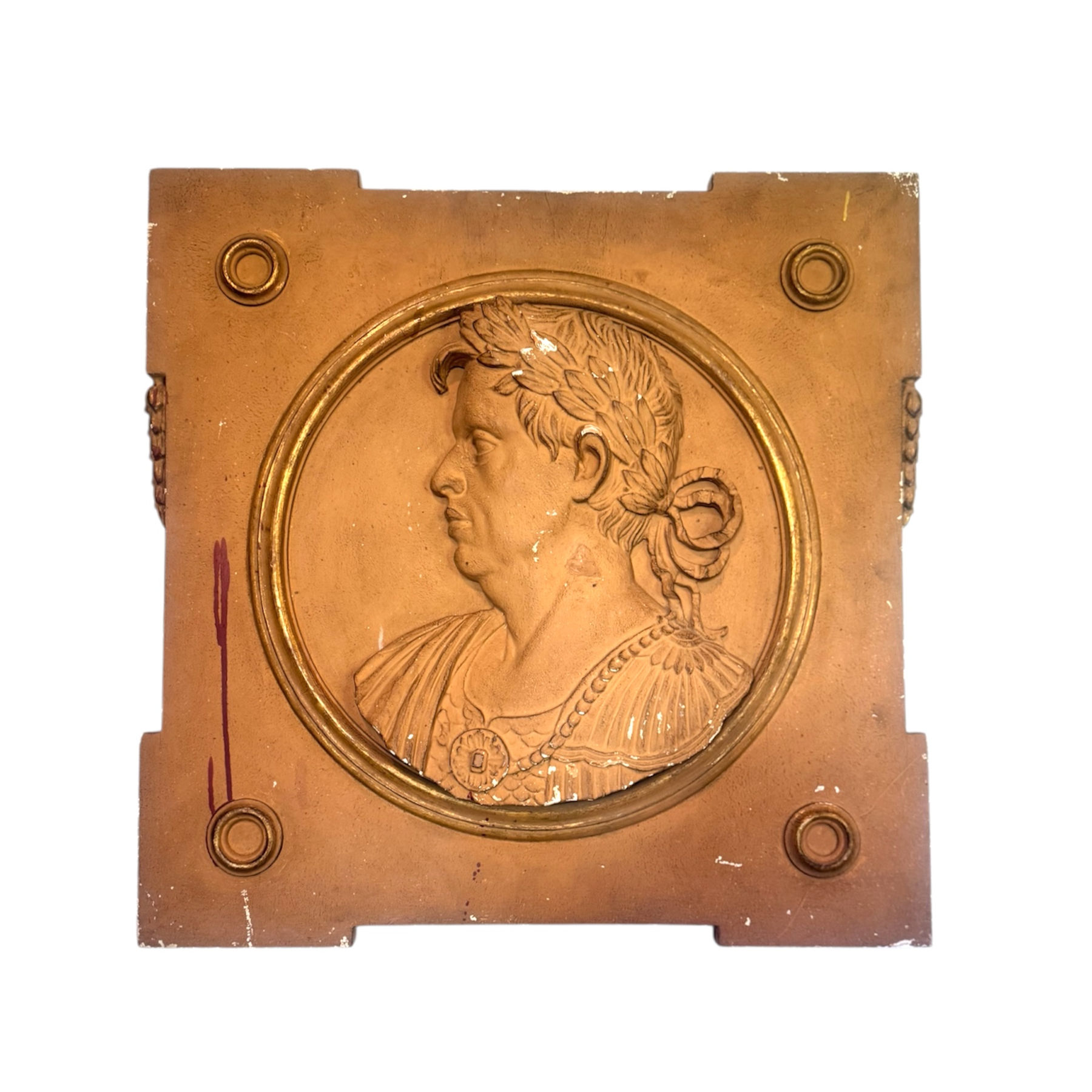

Roman Relief Plaque, Owned by Legendary Maximalist Iris Apfel
Neoclassical 19th/20th century Roman plaque depicting a man of honor, marked "VIII" on reverse, owned by Iris Apfel. Wood, gesso and terracotta paint with giltwood elements. This piece is in its original found condition having a burgundy paint drip and some chipped terracotta paint. If desired, we can have it fully restored.
Iris Apfel (1921-3024) was a legendary maximalist whose mantra was “More is more and less is a bore." Most know her for her signature oversized glasses and eccentric wardrobe, but what most don’t know… Iris had a successful interior design business that catered to NYC socialites like Estee Lauder, Greta Garbo, Faye Dunaway, and Joan Rivers. Naturally, her clientele wanted things that nobody else had.
She and her husband Carl traveled to Europe twice a year buying at auction, flea markets and estate sales filling up 40 ft containers for her design projects. They bought rare antique furnishings and textiles when Mid-Century modern was all the rage. Unable to source antique fabrics on a large scale for her projects, Iris reached out to a girlfriend from college whose father was a great weaver in Europe. She brought him her fabrics, which he reproduced using old world techniques. Soon after, they realized there was a niche market for antique replicas and formed a business partnership. In 1950, they founded Old World Weavers with a showroom in Manhattan, it became and still is one of the most esteemed textile companies in the industry specializing in 17th, 18th, and 19th century fabrics.
They were commissioned to renovate the White House over the course of nine presidencies (Truman, Eisenhower, Kennedy, Johnson, Nixon, Ford, Carter, Reagan, and Clinton.) In interviews she alluded to having discrepancies with America’s most fashionable icon of the time, First Lady Jacqueline Kennedy because she brought in French designers and textiles, which Iris removed thereafter. Carl and Iris ran Old World Weavers from 1950-1992, which now operates under Scalamandré. Her most iconic textile, a cut-velvet print called "Tigre” remains highly sought after today.
A New York native raised in Astoria, Iris grew up in a Jewish family that instilled in her an early appreciation for great design and craftsmanship. They were ideal role models cultivating her taste and style through their lifestyle. Her grandfather, a tailor, taught her the value of sewing and draping. Her mother, a fashion boutique owner, taught her the art of mixing different styles and eras by encouraging her to shop at thrift and antique stores in Greenwich Village. These early experiences helped refine her eye for rare and unique pieces, she understood the value of a curated mix and creating the unexpected. She was cutting edge, one of the first women to wear jeans in the 1940’s at a time when they were only made for men, she wore boys’ jeans.
Her father, an artisan glass shop owner, introduced her to the world of interior design when she accompanied him on a mirror installation at legendary, Elsie de Wolfe’s Plaza Hotel apartment. It made an enormous impression on young Iris, she claimed it nearly made her eyes pop out of her head. Elsie was America’s very first Interior Decorator to receive a design commission and in 1913 she published the first interior design book "The House in Good Taste.” Iris studied art and fashion in college. She began her career as a junior copywriter for Women’s Wear Daily before transitioning into interior design working as an assistant to Eleanor Johnson.
An interior design and fashion maximalist, her home and wardrobe were her greatest expressions of herself and most of all... for herself. Iris was the quintessential essence of individuality and style, following her gut buying things that spoke to her viscerally. The way she dressed was the same way she lived, an eccentric fun quirky mix of haute couture and thrifty treasures. The MET Costume Institute premiered an exhibition about her wardrobe titled "Rara Avis" (meaning rare bird): The Irreverent Iris Apfel. It was an enormous success, their first show featuring someone who was still living and not a fashion designer, it exhibited her collection of costume jewelry styled with clothes on mannequins as she wore them. It was so successful it became a touring exhibit followed by two documentaries "Iris” and “If You’re Not in the Obit, Eat Breakfast," a book "Iris Apfel, Accidental Icon," a Barbie of her, and a modeling contract at age 97! The Museum of Lifestyle and Fashion in Florida created a new building with a gallery to showcase her clothes, accessories and furnishings. She had homes in Manhattan and Palm Beach, plus a huge Long Island storage loft full of her European treasures, which is where this Roman plaque came from. It can be seen in her storage loft, in the 2014 documentary “Iris,” by Albert Maysles (see attached photo taken as it's seen in the documentary.) This is a special and meaningful historical collectible piece of fashion and culture!